


A Scientific Roadmap from TÜBA to COP31
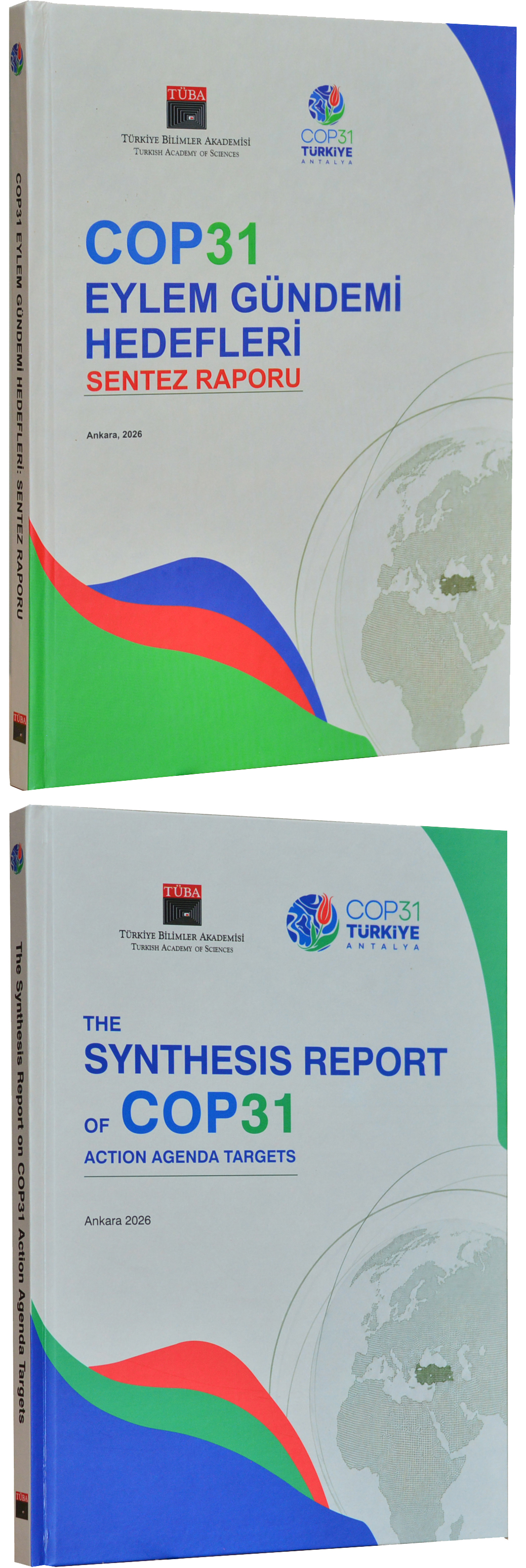 TÜBA, in line with the 2035 Global Implementation Targets set by the Presidency of the 31st Conference of the Parties (COP31), prepared the Synthesis Report on COP31 Action Agenda Targets in both Turkish and English. The Synthesis Report on COP31 Action Agenda Targets, has put forward science-based policy recommendations for combating climate change. Addressing the topics of environment, energy, urban planning, industry, education, and finance under a single umbrella, the report not only analyzes the current situation but also offers actionable roadmaps and concrete recommendations for countries to achieve their 2035 targets.
In his foreword to the report, TÜBA President Prof. Dr. Muzaffer Şeker noted that hosting COP31 represents a historic responsibility for Türkiye and emphasized that TÜBA’s interdisciplinary work over many years in the fields of climate change, energy, food, sustainable development, international relations, and artificial intelligence forms the foundation of this report. Prof. Dr. Şeker emphasized that the climate crisis can be managed not only through environmental policies but also through science, technology, and international cooperation, adding that the report serves as a scientific reference for decision-makers during the COP31 process.
President Şeker noted that science is humanity’s most reliable guide in the face of the climate crisis and expressed the hope that the report would contribute to fostering a common understanding among scientists, policymakers, and international organizations.
Prof. Dr. Şeker emphasized that artificial intelligence is a crucial tool capable of accelerating the fight against climate change across a wide range of areas, from early warning systems to energy management, and from carbon accounting to the protection of biodiversity; he also emphasized that these technologies must be developed in an ethical and human-centered manner. He also noted that environmental crises are fueled not only by climate change but also by wars and the unsustainable use of natural resources, highlighting that lasting environmental sustainability is only possible through lasting peace.
Why was the report prepared?
According to the report, prepared to provide a scientific basis for the 2035 Global Implementation Targets set forth by the COP31 Presidency, the fundamental problem today is not a lack of technology; rather, implementation is not progressing quickly enough, and countries need support in terms of financing and institutional capacity. While analyzing the obstacles to achieving global climate goals, TÜBA identifies which targets can be achieved with current technologies and existing knowledge.
What topics does the report focus on?
The study is structured around six key headings. Electrification, zero waste and methane reduction, climate-resilient cities, the circular economy, climate education, and the “Climate Implementation Bridge” model for implementing climate finance form the main pillars of the report. TÜBA emphasizes that these headings are not independent of one another but rather complementary policy areas.
One of the report’s most striking findings concerns the energy transition. While electricity currently accounts for approximately 21% of global final energy consumption, the report states that increasing this share to 35% by 2035 is both technically feasible and economically advantageous. To achieve this, the report states that the share of renewable energy in electricity generation must be increased from one-third to more than half, the use of fossil fuels must be significantly reduced, and investments in power grids and energy storage must be accelerated.
Regarding waste management, the report highlights that the world must focus not only on disposing of waste but also on redesigning resource use. Evaluations based on the example of Türkiye indicate that recycling investments significantly reduce carbon emissions, while it is emphasized that true transformation will only be possible through policies that reduce waste generation and are based on a circular economy. Under the heading of urbanization, attention is drawn to the high share of buildings in global carbon emissions. The report assesses that the widespread adoption of energy-efficient buildings, the retrofitting of existing buildings, AI-supported energy management, and climate-resilient urban planning are of critical importance for future generations. In the industry section, while it is noted that the use of raw materials must be reduced, recycling increased, and clean production technologies widespread, the goal is to raise the circular material usage rate to at least 15% by 2035. In the education section, it is stated that widespread education programs on climate change that reach the entire society are just as important as technology and finance.
31st Conference of the Parties (COP31), known in Turkish as the 31. Taraflar Konferansı, is the highest-level global climate negotiation platform where countries participating in the United Nations Framework Convention on Climate Change (UNFCCC) come together. The primary objective of COP31 is to develop joint solutions to the climate crisis, assess countries’ emission reduction commitments, and strengthen global solidarity. Throughout this process, the goals include implementing international climate policies (particularly the Paris Agreement) limiting global temperature rise to 1.5°C, supporting low-carbon development, and building more resilient societies.