

Tenzîlü'l-Efkâr fî Ta'dîli'l-Esrâr
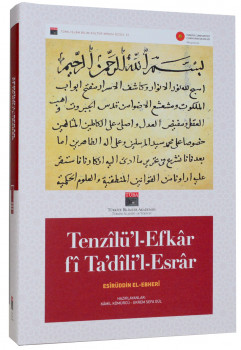
Ebherî, who lived in Anatolia in the 13th century, authored numerous works on metaphysics, physics, geometry, and astronomy in addition to his studies in logic. Prof. Dr. Kâmil Kömürcü and Dr. Ekrem Sefa Gül have prepared the critical edition, a brief evaluation, and the Turkish translation of Esîrüddin el-Ebherî’s work titled Tenzîlü’l-Efkâr fî Ta’dîli’l-Esrâr. With a few exceptions, most of this renowned thinker’s works exist only in manuscript form. Five copies of Tenzîlü’l-Efkâr fî Ta’dîli’l-Esrâr have been identified in libraries in Türkiye; all of these copies were examined in this study to prepare the critical edition. Written on the fundamental issues of Islamic thought, this book is one of the works that best summarizes the debates up to its own time. It consists of three sections: logic, metaphysics, and physics. These disciplines are further subdivided into articles, then chapters, and finally subheadings. The logic section of Tenzîlü’l-Efkâr reflects the Meşşâi understanding of logic. This is most clearly evidenced by the book’s division of logic into conception and affirmation, as well as its emphasis on the form of proof rather than its content. The book’s metaphysics section consists of five treatises. At the beginning of this section, the fundamental concepts of metaphysics, such as existence, essence, unity, multiplicity, necessity, possibility, cause, substance, accident, form, intellect, and category, are examined in general terms. The third and final field of study in Tenzîlü’l-Efkâr concerns classical physics.